I am fed up with the social conditioning for women to abandon themselves for everything and everyone else.
I see it so often with professional and entrepreneurial women, including women who are also mothers, caregivers, partners, friends, daughters, and community members. They are expected to do it all, care about everyone, succeed professionally, manage the invisible labor, tend to their relationships, take care of their health, and somehow still have enough energy left over to be patient, pleasant, attractive, available, and emotionally regulated.
It is an impossible standard, and yet, even when we know it is conditioning, many of us still buy into it. We still try to prove our worth, our strength, and how much we care by how much we can carry. We answer another email or text out of obligation, even when it’s late and we are exhausted. We say “yes” when our body has already said “no.” We ignore what we know we need because somewhere along the way, many of us learned that needing less, asking for less, and carrying more meant we were good.
That is the kind of martyrdom I am talking about.
This martyrdom is not the dramatic kind: the kind with a grand announcement or visible collapse. I am talking about the quieter kind that happens in everyday life, when a woman knows what she needs and overrides her Self anyway. She knows she needs rest, but keeps going. She knows she needs support, but tells herself she should be able to handle it. She knows she needs a boundary, but worries she will seem selfish, weak, difficult, or disappointing.
Because social media often shows the perfect and highly edited version of womanhood, business, motherhood, health, and success, it can become even easier to believe we are the ones falling short. We compare real life to something that is often curated, filtered, strategically framed, or created to sell us something. Sorry, not sorry, but a lot of it is not the reality of everyday life.
When I say “unsubscribe from martyrdom,” I am not saying to give up everything you do not want to do and only do what you want. I am not suggesting that you say “no” to everyone and everything all the time. I am not saying to stop caring about other people, responsibilities, causes, family, clients, or community.
This is not about becoming careless.
It is about becoming honest.
Get honest about what you can carry. Become honest about what is actually yours to carry. Honest about the support you need. Honest about what your body has been trying to tell you. No, this is also not where I pretend a bubble bath fixes patriarchy.
Women know what they need far more often than they are given credit for. I do not believe the issue is always lack of knowledge. Many women know they need to rest. They know they need to eat. They know they need help. They know they need to stop answering messages at night. They know they need to move their body, take a breath, have the conversation, set the boundary, or stop pushing past the point where their body is clearly asking them to pause.
The challenge is that knowing what we need and honoring what we need are not the same thing.
There is often a moment between the knowing and the action where the conditioning gets loud. That is the moment where a woman may ask herself, “Is this selfish?” or “What will they think?” or “Will they be disappointed?” or “Will I seem weak?” Sometimes the judgment doesn’t even come from anyone else. Sometimes the judgment is internal. It is the voice inside that says, “A ‘good’ woman would just handle this.”
That voice is not created in a vacuum.
In the room with men who have the same qualifications, women are still overlooked, discredited, interrupted, underpaid, underestimated, and expected to work twice as hard to be taken seriously. I have heard too many stories firsthand to pretend otherwise, so of course there can be pressure to prove. Of course there can be pressure to accomplish more, hold more, anticipate more, and need less.
I want to say this with care. I am writing from my lens as a white, straight, cis-gendered woman in a Western culture, and that matters. This reality is not the same for every woman in the world. Women of different skin colors, religions, cultures, abilities, income levels, family structures, and places in the world are navigating different expectations, risks, and consequences. Some women have more access to choice, support, safety, rest, money, and autonomy than others, so I am not pretending this is simple.
I am also not pretending that every woman can “just ask for help” and receive it easily. I think about the single mompreneur who is doing it all herself and juggling far too much without enough support. Yes, she may technically be able to ask others for help, but that does not mean help is readily available, affordable, consistent, safe, or emotionally uncomplicated. Some women genuinely do not have enough people to lean on.
That is why my message is not simply, “Ask for help.” Sometimes that is part of it, and sometimes it is a very important part of it. The deeper message is this: even when support is limited, your needs still matter. Your body still matters. Your Self still matters.
You do not have to abandon your Self to prove you care.
A person is usually only seen and recognized as a martyr after they are dead, not while they are living. No, you do not need to kill your Self to show how good, strong, caring, or capable you are. You do not need to slowly disappear inside your own life to prove your worth. You do not need to wait until your body forces you to stop before you are allowed to count.
Over time, this kind of self-abandonment can cost a woman deeply. It can impact her health, her relationships, her sense of Self, her peace, and her ability to enjoy the life she has worked so hard to build. It can turn care into resentment. It can turn ambition into exhaustion. It can turn generosity into depletion. It can make a woman feel like she is succeeding on paper while quietly losing access to her Self.
I know this pattern in my own life.
Early in my first business, I literally said, “I do not need anyone else. I can do it all by myself.” At the time, I thought that meant I was strong. I thought it meant I was capable. I thought it meant I was independent.
I was wrong.
What I eventually learned is that the belief that I had to do everything alone was not just independence, it was also armor. It was also a trauma response. I had confused being capable with not needing anyone, and those are not the same thing. Life taught me that I needed help. A lot of help. Not just in business, but in life.
There were years when I was isolated, disabled, and on the couch, unable to do much of anything due to debilitating chronic fatigue syndrome and POTS. I had to face the reality that I could not do it all alone. I had to receive support. I had to accept that needing help did not make me weak. Without that support, I would not be here in this space today.
That is part of why this matters to me so much. I am not speaking about this from theory. I am speaking as someone who has lived the cost of trying to be strong in ways that were not actually supporting me.
There is a difference between being capable and proving you should not need anyone. There is a difference between caring deeply and abandoning your Self. There is a difference between responsibility and Self-erasure.
Unsubscribing from martyrdom does not have to be dramatic. It may look like asking for help before you hit the wall. It may look like answering the text or email tomorrow instead of tonight. It may look like sitting down to eat without your phone, so you can actually eat, see, smell, and taste your food. It may look like taking one breath before automatically saying “yes.” It may look like disappointing someone gracefully while still maintaining your Self-respect.
None of this is selfish.
This is what would be expected of most men.
That is part of what makes this so uncomfortable. Many women have been conditioned to see basic Self-respect as selfishness. A man can be unavailable and he is busy. A woman is unavailable and she may worry she is being rude, cold, difficult, or uncaring. A man can protect his time and it is often seen as leadership. A woman protects her time and may feel the need to explain, soften, justify, or apologize.
I am not saying we should stop being thoughtful, or that we should lose our compassion. I am saying we can stop making Self-abandonment the proof of our goodness.
The shift is not from, “I care about everyone,” to, “I only care about my Self.” The shift is from, “I have to prove I am good, strong, and capable by handling everything,” to, “I am a strong, capable, caring woman, and I do not have to handle everything alone or prove my Self.”
That is not weakness. That is Self-respect. That is a woman telling the truth about her humanity.
When you read this and feel the part of you that still worries, “But what if I disappoint someone?” you might. Not because you are doing something wrong, but because some people are used to the version of you that over-functions, over gives, responds immediately, smooths things over, and carries more than is actually yours.
That does not mean you are wrong to change. It means the pattern is changing.
You can be loving and still have limits. You can be generous and still need support. You can be ambitious and still need rest. You can be strong and still have a body. You can care deeply about your work, your family, your clients, your community, and the world without abandoning your Self in the process.
So take a breath. Actually exhale. Feel into your body and ask your Self, “What do I need in this moment?”
Then listen.
Maybe you need to rest. Maybe you need to eat. Maybe you need to send the message tomorrow. Maybe you need to ask for help. Maybe you need to lower the impossible standard. Maybe you need to stop proving, just for one moment, and let your Self be a human being. Not perfectly, all at once, by pretending the world is fair, or that a bubble bath fixes patriarchy.
Rather, with one honest, Self-respecting choice at a time.
You do not have to abandon your Self to prove you care.
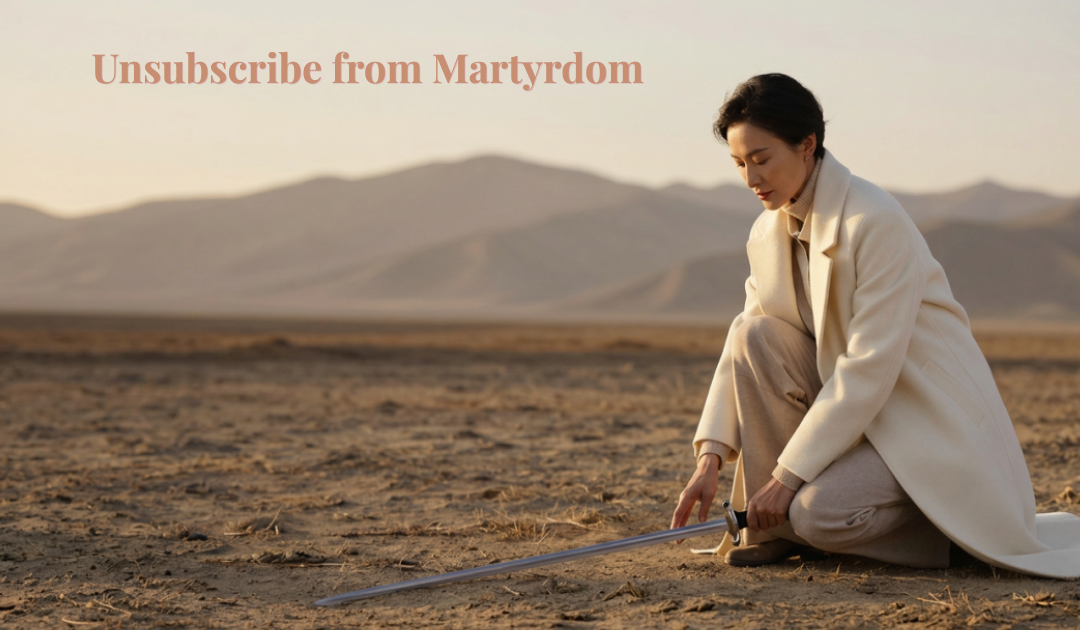
That is how you begin to unsubscribe from martyrdom.